
New Delhi has repeatedly missed opportunities for political engagement in Kashmir in the past. It must seize the next one, says Ajai Shukla.

'Young IFS officers today would take it for granted that they represent a major country with strengths and capabilities.' 'They will be aware that India is seen as one of the 10 significant countries in the world and therefore their voice will be heard whether on climate change or regime change,' says Ambassador B S Prakash.

'In India, China's capacities to conduct new types of warfare is critically underestimated,' says Claude Arpi.
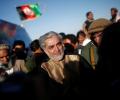
P B Chandra reports from Kabul on the Afghan presidential election, that has entered a run-off stage for the first time. The battle now is between the two frontrunners Abdullah Abdullah and Ashraf Ghani Ahmadzai, with Abdullah holding the edge.

The 2 countries signed 15 agreements including one on defence cooperation after Prime Minister Narendra Modi held 'productive discussions' with President Joko Widodo.

The founder of the Republican Hindu Coalition first attracted attention in the US as the "Punjabi tycoon" who was a huge supporter of Narendra Modi in the US. 'He will be best for India. There is no better ally for the US than India in the region,' Shalabh Kumar tells Rediff.com's Vaihayasi Pande Daniel.

The retail sector seeing a sharp rise in FDI flows is one where the Modi government's policy is not clear and has got a little muddled by its political ideology.
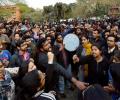
The State is trying to curb the students movements, therefore, there are suspicions against some of the Subramanian report on education's recommendations, says Mohammad Sajjad.

India must first improve working condition, then it can concentrate on Make in India concept.

Whether India can create labour-intensive factory jobs instead that it needs to put millions to work in the next few years looks very unlikely.

It is time to forge a credible New Delhi-Srinagar axis, says Ajai Shukla.

A summary of sports events and sports persons, who made news on Saturday
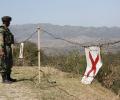
'The response to terror is not always reciprocal terror, nor is launching a conventional response the best response.' 'The best response is to make the sponsor pay a price he cannot afford,' says former RA&W chief Vikram Sood.

As India strives to make its Act East Policy a comprehensive politico-diplomatic and economic success, Brunei gains more salience, says Dr Rahul Mishra.

Here are the big takeaways from the debate.
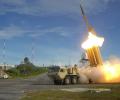
Deployment of THAAD in South Korea could unfold a new cataclysm in the Korean Peninsula with unwelcome prospects.

'It is a pattern of behaviour of the Chinese that whenever a Chinese leader visits India or an Indian leader visits China, some incidents take place.' 'When Modi visits China, we should look out for some similar demonstration by the Chinese.'
At scaling back Tehran's nuclear programme and relieving the Islamic Republic from the sanctions

United Progressive Alliance's abysmal performance and the Bharatiya Janata Party's claims of good governance are two factors that could change how India votes this year, says Shreekant Sambrani

New Delhi and Beijing are the only two regional capitals that have commented on US President Donald Trump's speech on August 21 outlining the way forward in Afghanistan. The Indian foreign ministry statement was effusive in praise, while the Chinese statement has been one of cautious and guarded hope. Delhi has identified itself with Trump's Afghan strategy, whereas the Chinese stance is calibrated -- observant and objective, keeping a distance, says Ambassador M K Bhadrakumar.

US Congresswoman Tulsi Gabbard, newly elected co-chair of the influential Congressional Caucus on India and Indian-Americans, discusses her vision for US-India ties with Rediff.com's Monali Sarkar.

The new PDP chief will have to work hard to keep everyone in the state happy.

Secretary Tillerson met with Foreign Secretary Jaishankar on Friday to discuss the US-India relationship and the agenda for Prime Minister Modi's meetings at the White House on June 26, a State Department spokesman said told PTI.

With EU, it is part of the FTA that we will need to negotiate.

The elements are all aligned to make India a global powerhouse, says IMF Managing Director Christine Lagarde.

'With the recent challenging of the notion of the Indian Ocean Region being India's strategic backyard, China is gradually upping the ante in the maritime realm around India.'

The state government has formed two committees under the chief secretary and the cane commissioner on the matter.

'How can Kashmir be demilitarised if the terrorist threat remains and Pakistan continues to incite elements in Kashmir to keep the internal situation unstable?' asks former foreign secretary Kanwal Sibal.

'Karna is the greatest warrior in the Mahabharata -- in fact, Arjuna is a nobody in front of Karna.' 'But Arjuna had a better advisor in Krishna than Karna.' 'Karna failed because he listened to the wrong advice given by Salya.' 'It just shows wrong advisors can land even the mighty in trouble.'

'This speech is going to be more of a punishment. I spoke too much this afternoon' A tireless Prime Minister Narendra Modi left over 700 notable luminaries in peals of laughter with his quick wit and sense of humour during a dinner and reception hosted by Indian Ambassador Subrahmanyam Jaishankar at the Taj-owned, The Pierre Hotel. In the presence of the who's who of desi Americans and US lawmakers, Modi once again thanked the Indian-Americans for their contributions and discussed his plans of developing India and the ties he hopes to nurture with America. Aziz Haniffa/Rediff.com presents a sneak-peak into the festive, grand dinner.
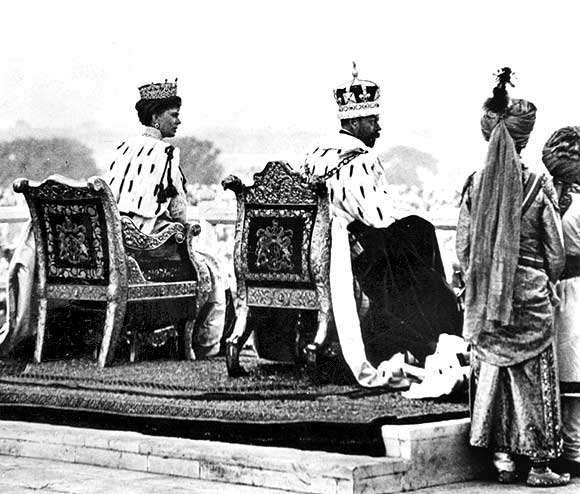
'I would recommend every young Indian reads Shashi Tharoor's book to get a perspective of our colonial past in the present day mesmerising euphoria of the global village in spite of Donald Trump, says Shivanand Kanavi.

'If Indian armed forces entered Pakistan and succeeded in inflicting major damage on the Pakistani army and occupied territory in the Pakistani heartland, there is reason to think the Pakistani military would use some nuclear weapons against the incoming Indian forces to compel India to stop.'

The Korean summit, laden with symbolism in everything from the choice of location to the mango mousse for dessert, could just be the first round in a continuing dialogue, says Dr Rajaram Panda.
'A President who is a living embodiment of high principles can tone up the entire national fabric,' says B S Raghavan, the distinguished civil servant.

'The real test will be in defence-related deals, for instance the Javelin anti-tank missile: Is the US willing to co-develop something with India, on terms that will support the 'Make in India' initiative? Is there defence technology transfer? Or will it dump old junk on India?' asks Rajeev Srinivasan.

In his penultimate State of the Union address, Barack Obama said that the economy is improving.
The 13-page joint statement issued after Prime Minister Manmohan Singh's annual summit with Russian President Vladimir Putin shows the breadth and depth of relations between the two countries and the trust factor that has been constant element behind it.

Darjeeling is on the boil over the demand for a separate Gorkhaland state. June and July are bad months to have a strike. Tea picking during its most valuable season has been affected. Those consequences will be felt all over the world and ultimately damage Darjeeling tea.

Prime Minister Narendra Modi has made his debut among the world's most powerful people, ranked 15th on the Forbes list topped by Russian President Vladimir Putin who pipped his US counterpart Barack Obama for a second year in a row.

Prime Minister Narendra Modi on Thursday address Members of the British Parliament in London where he promised to open more doors of cooperation between the two countries and delved on issues like terrorism and United Nations reforms.
